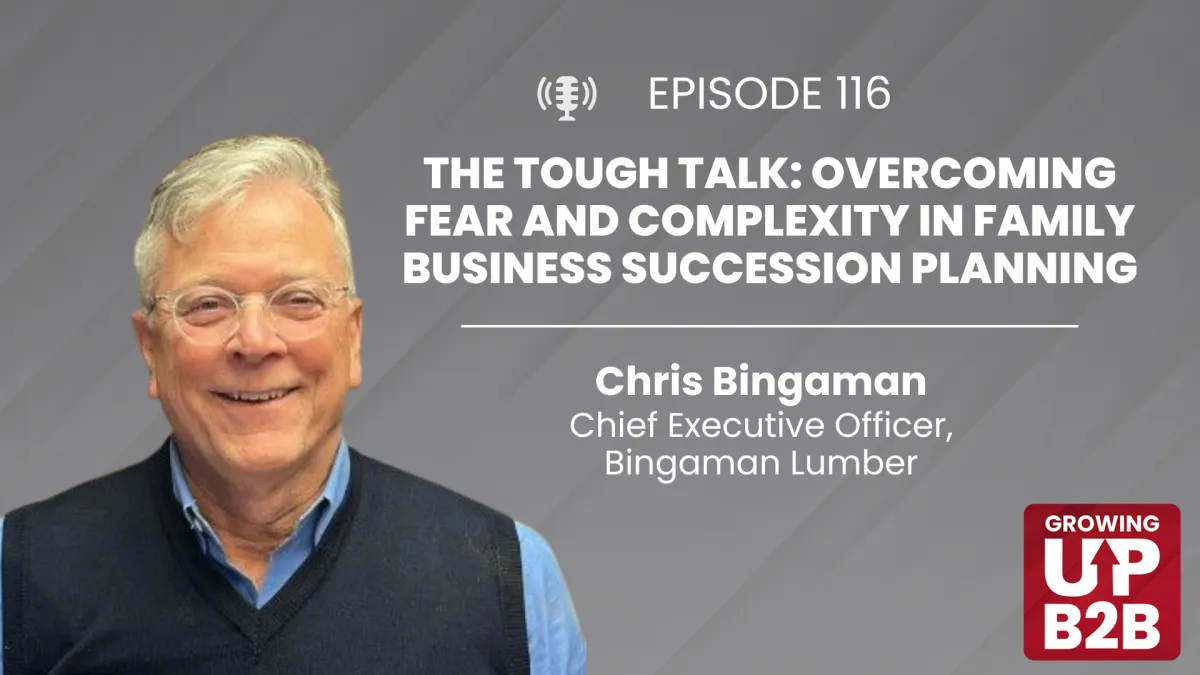
116 - The Tough Talk: Overcoming Fear and Complexity in Family Business Succession Planning
Navigating Family Business Leadership and Succession: Lessons from Bingaman Lumber’s Third-Generation CEO
In an insightful episode of the Growing Up B2B Podcast, host Ed Delia sits down with Chris Bingaman, CEO of Bingaman Lumber, to unwrap the sophisticated governance and capital investment strategies required to preserve a multi-generational manufacturing enterprise. Celebrating over 80 years of industrial excellence, the company's trajectory serves as a definitive case study in conquering the traditional "third-generation curse." Chris shares a transparent, look at how his family dismantled convention by appointing a non-family president, illustrating how mid-market firms can systematically transition from informal, lineage-based defaults to rigorous, objective corporate frameworks that secure long-term market dominance.
Professionalizing the Industrial Enterprise: Objectivity, AI, and Employee Ownership
The transformation of a legacy lumber and manufacturing firm from a founder-dependent operation into a scalable, corporate powerhouse demands an aggressive shift away from purely lineage-based succession planning. Chris explains that true generational stewardship requires confronting the emotional discomfort of exit planning head-on, replacing family assumptions with rigorous, objective profiling tools and independent advisory board feedback. By decoupling family ownership from operational management, the leadership team successfully institutionalized a professional meritocracy where talent alignment takes precedence over bloodlines. This disciplined approach ensures that the "messy middle" of a leadership transition is managed with absolute structural transparency, giving long-standing employees and non-family executives the clarity needed to execute long-term strategic objectives.
[Image demonstrating an industrial digital transformation roadmap showing the integration of manufacturing automation and data-driven corporate governance]
Sustaining a competitive moat in a contracting industrial sector also requires a continuous, multi-million-dollar embrace of emerging technological assets. Chris details Bingaman Lumber's calculated leap of faith in executing its largest-ever capital investment to integrate artificial intelligence-driven camera systems and automated defect-recognition tools directly onto the production floor. By automating technical lumber-grading processes that were historically reliant on subjective human memory, the manufacturing operation has achieved unprecedented quality control and predictive processing speeds. This tech-forward approach minimizes operational risk and compresses the cash conversion cycle, proving that legacy manufacturers must treat advanced automation as a strategic imperative to elevate yield and service modern, high-velocity B2B market demands.
Furthermore, future-proofing a multi-generational brand requires transforming the workforce from simple labor into true stakeholders through innovative equity models. Under Chris's strategic guidance, the corporation established an Employee Stock Ownership Plan (ESOP), shifting 35% of company equity directly into the hands of the workforce to foster a culture of collective responsibility. This structural alignment reduces labor turnover and serves as a powerful talent magnet when paired with an authentic, employee-led digital branding strategy on modern media channels. By focusing on specialized, high-value boutique products and combining rigorous operational data with a deep-rooted commitment to human capital, this multi-generational business demonstrates how traditional heavy industries can ruthlessly professionalize their governance to ensure multi-decade commercial resilience.
About Chris Bingaman
Chris Bingaman is the CEO of Bingaman Lumber and a veteran third-generation industrial executive specializing in corporate succession planning, manufacturing automation, and employee ownership structures. With decades of hands-on technical and leadership experience, Chris focuses on professionalizing family-governed enterprises, helping mid-market firms implement data-driven operational metrics, and driving sustainable business scale through the integration of artificial intelligence and advanced wood-processing technology.
About Bingaman Lumber
Bingaman Lumber is a world-class, multi-location manufacturer and global exporter specializing in high-quality, sustainably sourced domestic hardwoods, thermally modified wood, and custom component parts. Utilizing state-of-the-art automated pre-drying, kiln-drying, and AI-powered grading infrastructures, the company delivers vertically integrated lumber solutions to a diverse international B2B audience across the furniture, millwork, and industrial distribution sectors, combining heavy-industry scale with an uncompromising commitment to corporate integrity.
Links Mentioned in This Episode
Guest Company: Bingaman Lumber
Guest LinkedIn: Chris Bingaman on LinkedIn
Key Episode Highlights
The Non-Family Paradigm: The strategic necessity of hiring an outside president to bridge leadership gaps, eliminate internal family friction, and professionalize corporate governance.
The AI Grading Revolution: Lessons from implementing a massive capital project that integrated automated vision cameras and machine learning onto a traditional manufacturing floor.
The ESOP Moat: Utilizing an Employee Stock Ownership Plan to align workforce incentives, drive shop-floor innovation, and secure long-term talent retention.
Confronting Succession Fear: Overcoming the emotional bottlenecks and procrastination surrounding mortality and legacy transitions through objective assessment metrics.
Culture-Led Brand Storytelling: Empowering younger, frontline employees to manage modern digital channels to attract next-generation trade talent and build deep market trust.
Conclusion
Chris Bingaman’s real-world insights demonstrate that the longevity of an industrial family business relies entirely on shifting from a reactive operational posture to an intentional, data-driven strategy. By professionalizing human capital through employee ownership and treating technological evolution as a non-negotiable anchor, middle-market manufacturing leaders can transform their heritage from a static history into a powerful, scalable engine for generational growth.
Ready to maximize your business value and secure your market position? Elevate your market presence and drive enterprise growth today—discover how our team at Delia Associates can partner with you to uncover high-impact brand strategies by exploring our B2B brand development and growth services.
Are you an ambitious B2B executive with game-changing industry insights to share with an elite business audience? Join the definitive executive conversation on legacy, strategy, and scale—we invite you to share your story of commercial resilience and innovation by applying to be a featured executive guest on the Growing Up B2B Podcast here.