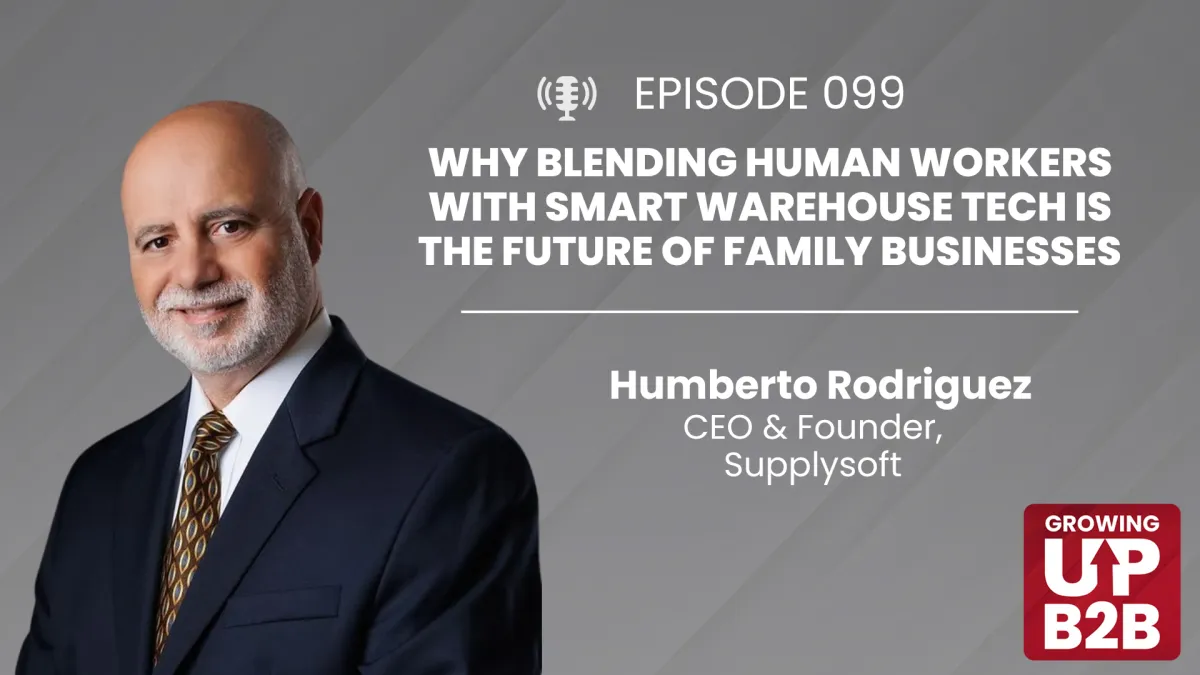
99 - Why Blending Human Workers with Smart Warehouse Tech Is the Future of Family Businesses
Scaling Through Strategy: How Family Businesses Thrive in the Digital Age with SupplySoft
In the latest episode of the Growing Up B2B Podcast, host Ed Delia sits down with Humberto Rodriguez, CEO and Founder of SupplySoft, to deconstruct the digital evolution of family-governed enterprises. Humberto shares his journey from translating complex computer science concepts for garment district entrepreneurs to leading a premier provider of warehouse management systems (WMS). Their conversation offers a masterclass in identifying the "red flags" of stagnant operations and the strategic steps required to move from tribal knowledge to a scalable, tech-enabled business model. For any B2B leader looking to bridge the gap between legacy values and modern operational efficiency, this episode provides the blueprint for sustainable growth.
Professionalizing the Warehouse: From Tribal Knowledge to Scalable Systems
The transition from a small family operation to a scalable B2B enterprise hinges on the ability to move beyond "tribal knowledge"—where critical operational data lives only in the heads of a few veteran employees. Humberto explains that the first indicator of a scalable warehouse is the "Step Rule": the physical ability to navigate a workspace without being obstructed by disorganized inventory. This physical order is often a direct reflection of the underlying digital systems; without a robust WMS to track movement, a warehouse becomes a bottleneck rather than a growth engine. By documenting processes and implementing user-friendly tools like automated pick carts, businesses can reduce their reliance on individual memory, making it possible to onboard new talent rapidly and maintain accuracy even during peak seasons.
Overcoming the "we’ve always done it this way" mentality is perhaps the most significant hurdle for multi-generational firms. Humberto argues that successful change management starts with acknowledging the achievements that built the foundation of the business, while clearly framing new technology as a support system for the people who drive the company forward. Technology shouldn't be implemented for the sake of trends; it should be positioned as a bridge that solves specific market pain points, such as the need for faster throughput or better data-driven insights. By involving key stakeholders early and piloting low-risk projects, family businesses can demonstrate tangible value, turning skeptics into internal champions for digital transformation.
As the B2B landscape shifts toward AI and automation, the role of leadership must evolve from day-to-day implementation to strategic advisory. Humberto highlights that laying a solid foundation with a modern ERP and WMS is a non-negotiable prerequisite for leveraging future technologies like predictive analytics and robotics. Building a predictable growth engine also requires moving beyond a "referral-only" mindset; sustainable scaling demands a proactive go-to-market strategy that includes internal business development and a unified brand presence. By blending deep-rooted human expertise with the power of modern systems, small and mid-sized businesses can not only compete with global giants but also preserve their unique family legacy for generations to come.
About Humberto Rodriguez
Humberto Rodriguez is the CEO and Founder of SupplySoft, a leading expert in supply chain technology and warehouse optimization. With a background in computer science and decades of experience advising family-owned businesses, Humberto specializes in helping SMBs professionalize their operations through the strategic implementation of warehouse management systems and automated workflows.
About SupplySoft
SupplySoft is a technology firm dedicated to empowering small and mid-sized businesses with enterprise-grade supply chain solutions. The company provides intuitive warehouse management software and advisory services that streamline inventory tracking, increase order accuracy, and enable scalable growth for family-governed organizations.
Links Mentioned in This Episode
Guest Company: SupplySoft
Guest LinkedIn: Humberto Rodriguez on LinkedIn
Key Episode Highlights
The Step Rule: Why physical organization in a warehouse is the ultimate indicator of an organization's readiness to scale.
The "Translator" Role: The value of acting as a bridge between complex technology and the practical needs of traditional family business owners.
Knowledge De-siloing: How documented SOPs and user-friendly WMS tools prevent "tribal knowledge" from becoming a business-ending vulnerability.
Go-to-Market Evolution: Moving from an unpredictable referral-based growth model to a systematized internal sales and marketing engine.
AI Readiness: Why foundational data collection today is the only way to leverage predictive optimization and robotics tomorrow.
Conclusion
The dialogue between Ed and Humberto highlights that the future of B2B manufacturing and distribution isn't about replacing the human element, but empowering it. By professionalizing systems and embracing a culture of continuous improvement, family businesses can transform their legacy into a dynamic, tech-enabled powerhouse ready for the challenges of the next generation.
Explore Ed Delia’s website to learn more about leadership strategies for family businesses and B2B growth. If you’re a B2B leader with insights to share, apply to be a guest on the Growing Up B2B Podcast here.