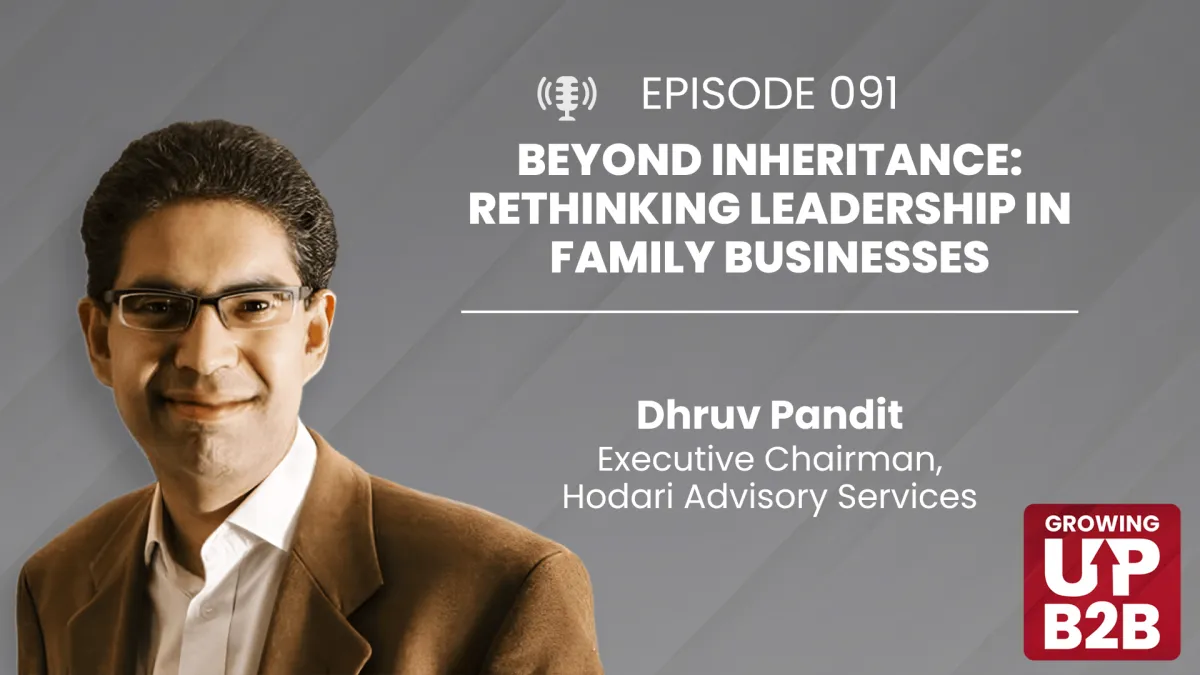
91 - Beyond Inheritance: Rethinking Leadership in Family Businesses
Navigating Generational Change in Family Businesses: Lessons from Dhruv Pandit on Growing Up B2B
In this profound episode of the Growing Up B2B Podcast, host Ed Delia sits down with Dhruv Pandit, Executive Chairman of Hodari Advisory Services, to deconstruct the intricate journey of a multi-generational family enterprise. From its 1950s roots in insurance to its modern evolution as a sophisticated investment and advisory group, the Pandit family story is a masterclass in strategic adaptation. Their conversation provides an essential roadmap for B2B leaders navigating the delicate intersection of legacy and innovation, offering high-level insights into how families can professionalize their governance without losing the entrepreneurial spark that built their foundation.
Professionalizing the Family Office: Balancing Governance, Passion, and Legacy
The transition from a founder-led operation to a multi-generational enterprise requires a fundamental shift from informal management to structured governance. Dhruv explains that the "family office" model serves as a critical hub, providing the professional infrastructure—financial analytics, legal oversight, and project management—needed to manage diverse assets while protecting family harmony. By establishing clear "decision domains" and documenting family employment policies, a business can replace emotional friction with objective accountability. This structure allows family members to wear different "hats" effectively, distinguishing their roles as owners, managers, or relatives depending on the setting, which ensures that the business remains a source of joy rather than an obligatory burden.
A successful B2B legacy is a double-edged sword; it can either serve as a sturdy foundation for growth or a rigid constraint that stifles innovation. Dhruv emphasizes the importance of a "stewardship mindset," where current leaders view themselves as custodians rather than absolute owners. This perspective grants the family the "emotional distance" required to make objective pivots—such as exiting highly regulated legacy sectors to redeploy capital into more fertile markets. By encouraging the next generation to find their own passion within the business ecosystem rather than mandating participation, a family ensures that its leadership remains vibrant and committed. Governance should ultimately enable entrepreneurship, providing a safe space for candid dialogue and a framework for conflict resolution that honors the past while aggressively pursuing the future.
Furthermore, the isolation often felt at the top of a family firm can be mitigated by engaging with global peer networks. Dhruv highlights how participating in international family business forums provides access to alternative governance models and confidential support from those facing identical challenges. These external perspectives are invaluable when bringing in non-family leadership, as they help clarify the specific mix of professional competence and values alignment required for an outsider to thrive within a family culture. By prioritizing open communication and maintaining a family charter, leaders can ensure that their core values remain non-negotiable anchors during times of rapid market change or internal transition.
About Dhruv Pandit
Dhruv Pandit is the Executive Chairman of Hodari Advisory Services and a seasoned leader in the realm of family enterprise governance. With a career spanning financial services, real estate, and strategic advisory, he specializes in helping multi-generational families professionalize their operations, manage complex successions, and redeploy capital into high-growth sectors across the African continent and beyond.
About Hodari Advisory Services
Hodari Advisory Services is a specialized firm dedicated to providing strategic guidance and investment oversight for family offices and private enterprises. The company focuses on bridging the gap between traditional family values and modern corporate discipline, offering expertise in governance structures, capital allocation, and the professionalization of legacy businesses.
Links Mentioned in This Episode
Guest Company: Hodari Advisory Services
Guest LinkedIn: Dhruv Pandit on LinkedIn
Key Episode Highlights
The Strategic Pivot: How to recognize when a legacy business model is no longer competitive and have the courage to redeploy capital into new ventures.
The "Hats" Metaphor: A framework for clarifying roles in family meetings to distinguish between ownership, management, and family interests.
Passion over Obligation: Why forcing the next generation into the business is a recipe for failure, and how to nurture interest through exposure instead.
Governance for Stewardship: Building a family office that acts as a professional hub to support both the family's assets and its individual members' aspirations.
External Leadership Alignment: The critical importance of hiring non-family executives based on values alignment and communication skills over technical expertise alone.
Conclusion
Dhruv’s journey highlights that the longevity of a B2B family business isn't found in holding onto the past at all costs, but in the ability to evolve while keeping core values intact. By professionalizing governance and honoring the unique passions of each generation, family enterprises can transform from stagnant relics into dynamic, multi-generational engines of wealth and impact.
Explore Ed Delia’s website to learn more about leadership strategies for family businesses and B2B growth. If you’re a B2B leader with insights to share, apply to be a guest on the Growing Up B2B Podcast here.